British Parliamentary International Debate
British Parliamentary debate or BP, is the most popular style of intercollegiate debating in the world. It is the format used at the annual World Universities Debating Championship (WUDC). Some people refer to BP as “Worlds” or “WUDC format”.
The tournament will follow a British Parliamentary Debate format where there shall be 4 teams participating in one round with two Speakers in each team. Two teams represent the Government (in support of the motion), and two teams represent the Opposition (opposed to the Government and motion). Participants will be informed of their team’s position in a given round just before the motion is announced.
Here are the general names of the teams and the names of the individual roles:
Opening Government (OG)
Prime minister & Deputy
Prime Minister
Opening Opposition (OO)
Leader & Deputy Leader of Opposition
Closing Government
Member of Government & Government Whip
Closing Opposition (CO)
Member of Opposition & Opposition Whip
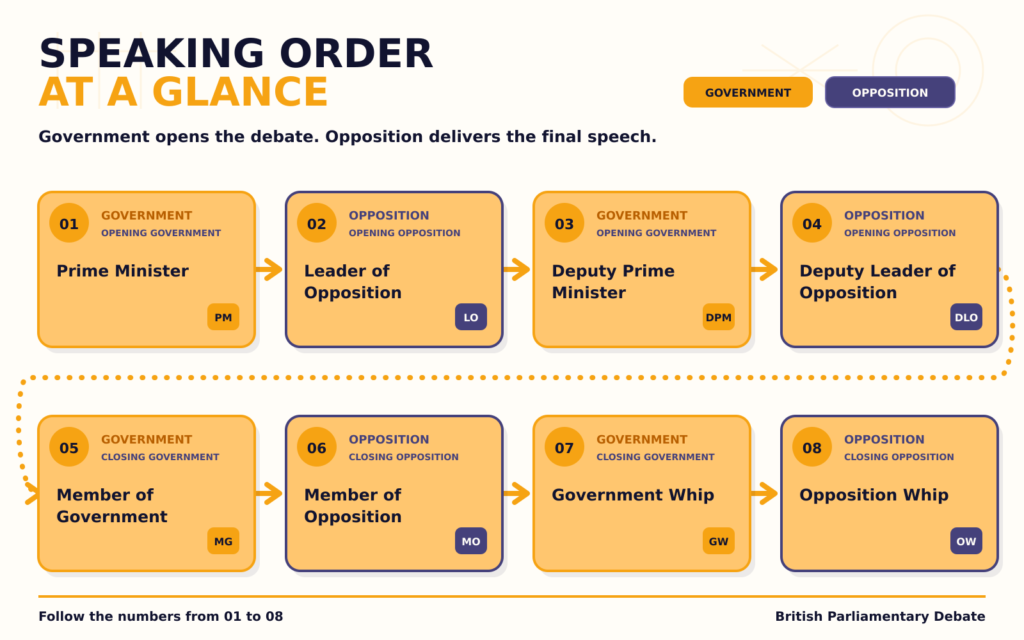
The Government opens the debate, and the Opposition delivers the final speech. Each speaker presents one 7-minute speech. The speeches proceed in this order:
- Prime Minister
- Leader of Opposition
- Deputy Prime Minister
- Deputy Leader of Opposition
- Member of Government
- Member of Opposition
- Government Whip
- Opposition Whip
The speakers speak in rotation, beginning with the first team member of 1st Proposition (“the Prime Minister”). They are followed by the opening speaker for 1st Opposition (“Leader of the Opposition”), who in turn is followed 1st Proposition’s second speaker (“the Deputy Prime Minister”), who is followed by 1st Opposition’s second speaker (“Deputy Leader of Opposition”), who is followed by 2nd Proposition’s first speaker (“Member of Government”), who is followed by 2nd Opposition’s first speaker (“Member of Opposition”), who is followed by 2nd Proposition’s second speaker (“Government Whip”), who is followed by 2nd Opposition’s second speaker (“Opposition Whip”).
Opening Government (OG)
Prime Minister
The job of the PM is to present a debatable, persuasive case in support of the motion. To this end, a speaker should:
- Define the motion: This might include: defining specific terms in the motion, advocating specific policychange(s), and/or articulating the roles of relevant stakeholders.
- Provide a complete case: Establish that a problem exists, and provide reasons why your team’sadvocacy resolves it. If necessary, signpost the new material your partner will add.
- Avoid being too clever: Aim to set up a debatable case that supports the most obvious interpretation ofthe motion.
Deputy Prime Minister
The DPM closes for the Opening Government, and should:
- Rebuild: Defend your team’s case by answering the LO’s refutation. Reiterate the key elements of yourteam’s position.
- Refute the LO’s case: Be specific. Criticize what you’ve just heard. Compare it to your team’s position.
- Follow through on promises: If your partner declared that you would present new material in support of your team’s position, do so. At the very least, add depth to the original case by providing additional details, examples, or explanation.
Opening Opposition (OO)
Leader of Opposition
The Leader should oppose the motion and the case presented by the PM.
- Refute the PM’s case: Be specific. Criticize the case you’ve just heard.
- Oppose: Why is the motion itself problematic? State your team’s position and provide reasoning to support it. As you prepare for this speech, consider that the motion might possibly do more harm than good, foreclose better alternatives, or be tethered to a destructive worldview.
- Recognize that the first two tasks on this list are not always separate: A good PM speech will allow you to oppose both at the same time.
Deputy Leader of Opposition
The DLO concludes the first half of the debate for the Opposition, and should:
- Rebuild: Defend your partner’s case from the DPM’s refutation. Reiterate the key elements of your team’s position.
- Refute: Address new, relevant material presented by the DPM. Illustrate any important tension(s) between the PM & DPM speeches. Highlight LO refutation that was ignored or insufficiently covered by the DPM.
- Add depth: Add something to your team’s case. You can provide additional examples, explanation, or analysis to support a previous claim. You can present a new argument.
Closing Government (CG)
Member of Government
The Member of Government opens the second half of the debate, and should:
- Refute: Address any new contribution(s) from the DLO. Consider engaging in holistic refutation of the OO,or even preempting what the CO is likely to claim.
- Offer an “extension”: Add something new. You might choose to present an entirely new argument, or youmight opt to develop an important argument that the OG underdeveloped.
- Explain how the CG’s position fits into the debate: Avoid contradicting the OG case. Explain why whatyou’re adding is important in relation to the OG case.
Government Whip
The Government Whip should:
- Identify the 2-3 most relevant concepts in the debate: These concepts should serve as the main pointsof your speech. At some point, explain why your conceptual breakdown is the best way to view thedebate.
- Sell the “extension”: Demonstrate how your team’s material relates to other important content in thedebate. Articulate why your position defeats the most important arguments presented by the Opposition.
- Refute: Answer the contribution made by the Member of Opposition. Engage in holistic refutation of theOpposition.
- Avoid making new arguments: You may, however, add details or examples in support of previous claims.
Closing Opposition (CO)
Member of Opposition
The Member of Opposition should:
- Refute: Answer the new material presented by the Member of Government. Consider engaging in holisticrefutation of the entire Proposition bench. Look for and exploit contradictions/tensions between the OG &CG.
- Make a contribution: Add something new. You might choose to present a new argument or to furtherdevelop an OO argument.
- Explain how the CO’s contribution fits into the debate: Illustrate why your position is important inrelation to the OO case. Avoid contradicting the OO if you can.
Opposition Whip
The Opposition Whip closes the debate, and should:
- Identify the 2-3 most relevant concepts in the debate: The CG will have just done this. Identify differentconcepts. Argue why your concepts are more relevant than the CG’s concepts in understanding thecompeting claims. The concepts you identify should then serve as the main points of your speech.
- Sell your contribution: Explain how your team’s position relates to other important arguments in thedebate.
- Avoid making new arguments: You may, however, add details or examples in support of previous claims.
Each speaker shall speak for 7 minutes
Points of information are not allowed during the first and the last minute of the speech.
Each speaker is encouraged to allow at least 2 points of information.
All rounds are presided by a single judge bench/chair. After the conclusion of all speeches, the chair asks the participants to leave the room. The chair then spends a few minutes deciding the debate. Each team is given a ranking (first place, second place, third place, fourth place). Each speaker is assigned a speaker score on a scale of 0-100. When the decision is finalized, the judge invites the debaters back into the room. The decision is announced and the chair provides some reasoning to support the rankings.
All speeches shall be ranked and an aggregate score of both the speakers leads to team ranking.
The top 32 teams then, shall progress to the Pre-Quarter Finals. From the Pre- Quarter Finals, the top 16 ranked teams shall progress to the Quarter Finals. From the Quarter Finals, the top 8 ranked teams shall progress to the Semi Finals. From the Semi Finals, the top 4 ranked teams shall progress to the Finals. The top ranked team shall be the Winner and the 2nd ranked team shall be the Runners-up of the Tournament.
All teams must mandatorily be present in the Vijaybhoomi University Campus for the qualifying rounds.